
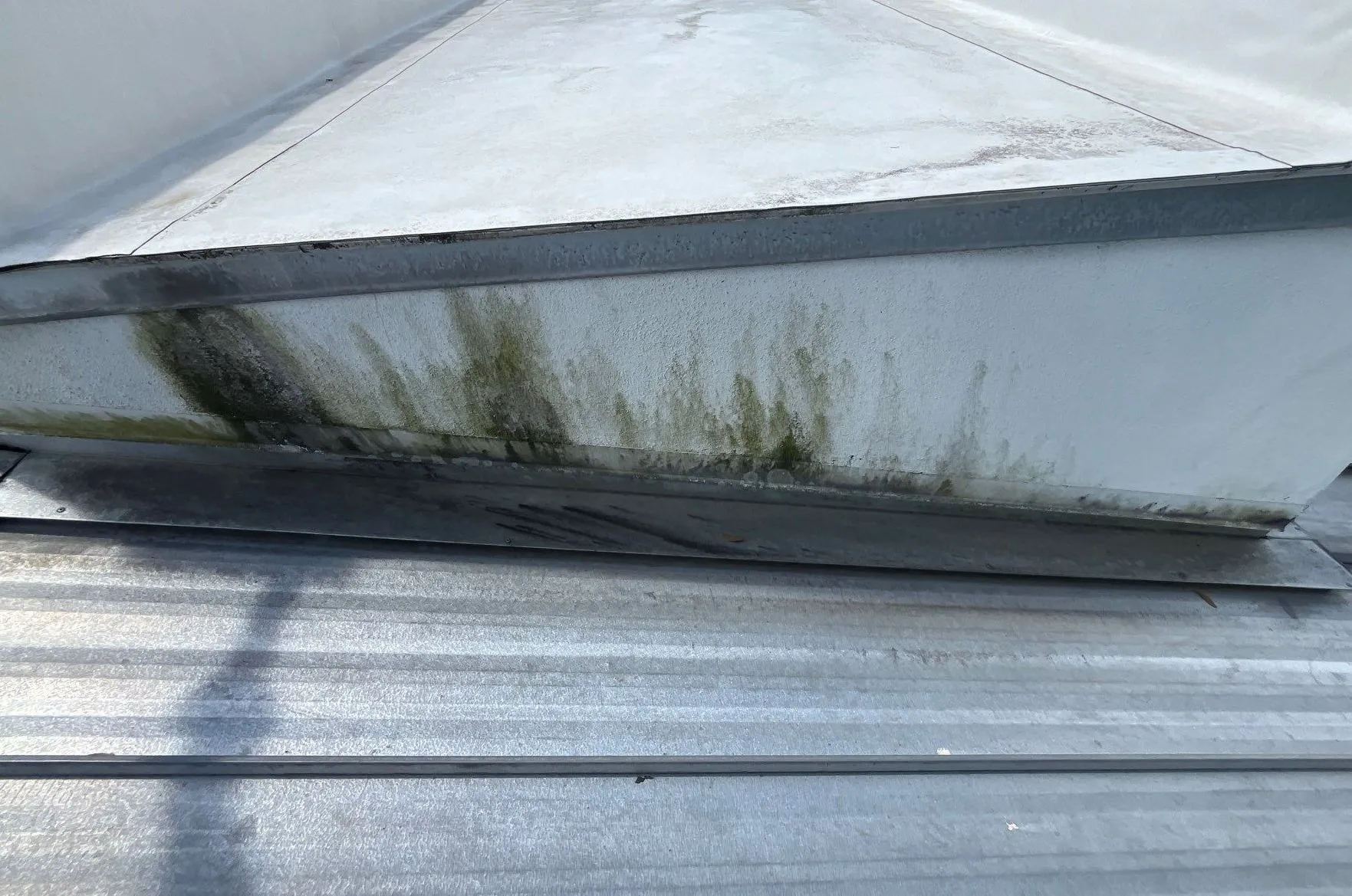
A TPO roof usually leaks because a seam wasn't heat-welded correctly and has separated, the membrane has been punctured, or flashing has failed around an HVAC curb, pipe, drain, or other penetration. Older systems can also shrink and wear from UV exposure, which puts added stress on seams and attachment points. One isolated defect is often repairable. Multiple seam failures, widespread moisture, or an aging membrane usually point to replacement.
TPO is a single-ply membrane commonly used on commercial flat and low-slope roofs. Its field sheets, seams, edges, drains, and penetrations have to work as one watertight system. Manufacturer instructions call for continuously welded details around penetrations, and note that roof expansion and contraction can stress welded seams.1
What Each TPO Leak Cause Means for the Repair Decision
Seams that were not welded correctly
TPO sheets are joined with hot-air welds. If the installer used the wrong heat, speed, pressure, overlap, or surface preparation, part of the seam may never form a reliable bond. Thermal movement then pulls at that weak point until water gets underneath.
A short, isolated open seam on an otherwise sound roof is usually a repair candidate. A commercial roofer can clean and prepare the membrane, re-weld the area, and test the finished seam. Multiple separating seams across different roof areas point to a system-level problem — in that case, spot repairs may just move the next leak somewhere else.
Punctures and cuts in the membrane
Foot traffic, dropped tools, HVAC service work, sharp debris, loose fasteners, and equipment movement can all puncture a TPO sheet. A small puncture with dry insulation below it can often be fixed with a compatible welded patch.
That changes if inspection or moisture testing shows water has reached the insulation or roof deck. Core samples can help confirm whether existing insulation is wet before a repair or replacement scope is approved.
Flashing failures around HVAC units, pipes, drains, and walls
Every penetration interrupts the main membrane field and needs a watertight transition. Pipe boots, penetration pockets, HVAC curbs, drains, parapet walls, and roof edges are the usual inspection points. Manufacturer details call for continuous welds and properly supported flashing around each one.1
A failed boot, curb corner, drain detail, or short flashing section is often repairable when the surrounding membrane is still flexible and the insulation is dry. Replacement becomes more likely when several details are failing at once, the membrane has pulled away at the perimeter, or wet insulation extends well past the leak source.
Age-related wear, movement, and surface deterioration
Age alone doesn't mean a TPO roof needs replacing. GAF has reported that TPO samples from roofs 8 to 16 years old generally still met current ASTM requirements, and some U.S. TPO roofs have stayed in service for more than 20 years.2
Condition matters more than the calendar. A 15-year-old membrane with flexible material, sound seams, good drainage, and isolated damage may still be worth repairing. A roof in the 15-to-20-plus-year range with brittle areas, recurring leaks, widespread seam separation, saturated insulation, or perimeter movement is a stronger candidate for replacement.
TPO Roof Repair vs. Replacement: Decision Factors
The table below lines up the seven factors that most often decide whether a commercial TPO roof leak calls for a targeted repair or a full replacement.
Scroll sideways to view the full table.
| Decision Factor | Repair Is Usually the Better Fit When | Replacement Is Usually the Better Fit When |
|---|---|---|
| Leak pattern | One seam, puncture, boot, drain, or flashing detail is failing | Leaks recur in several roof areas or several seams are opening |
| Moisture below the membrane | Insulation and deck are mostly dry | Moisture is widespread or insulation has lost performance |
| Membrane condition | TPO remains flexible and accepts a reliable weld | Membrane is brittle, badly weathered, contaminated, or difficult to weld |
| Roof age | The roof is relatively young and otherwise sound | The roof is near the end of its expected service period and failures are increasing |
| Drainage and structure | Drainage works and the deck is sound | Ponding, deck deterioration, or insulation damage requires broader correction |
| Cost pattern | One defined repair buys useful service life | Repeated repairs are consuming capital without stabilizing the roof |
| Business impact | Work can be isolated with limited disruption | Planned replacement reduces the risk of repeated emergency work and interior damage |
Key Insights
- No single factor decides the outcome on its own. A young roof with widespread wet insulation, or an older roof with one isolated and repairable defect, both call for a closer inspection rather than a default answer based on age alone.
- Recurring leaks in different areas of the same roof are one of the clearest signals that a system-level problem, rather than a single defect, is driving the failures.
- Business impact is a real factor alongside the physical condition of the membrane. Planned replacement work can reduce the risk of repeated emergency calls and interior damage compared with an ongoing pattern of reactive repairs.
What Repair Costs and What It Buys You
A commercial roofing cost guide published in 2025 puts targeted repairs around $3 to $10 per square foot, depending on the defect, access, wet insulation, and how much diagnostic work is needed.4 These per-square-foot figures usually apply to a limited, labor-intensive repair area, while replacement pricing spreads mobilization and installation costs across the whole roof. The two ranges are planning benchmarks for different scopes, not proof that one option will always cost less. A contractor may also price a small repair as a minimum service call rather than by square foot. Treat these figures as planning guidance, not a Florida project quote.
Repair buys time when the failure is limited and the rest of the system is sound. A properly completed repair can stop an isolated leak, restore a seam or flashing detail, and protect dry insulation. It doesn't reset the age of the whole roof or fix weak seams elsewhere. Ask the inspection team to define the leak source, the wet area, the repair boundary, and the expected remaining service life before approving the work.
What Replacement Costs and What It Buys You
An April 2026 commercial roofing cost guide puts 60-mil TPO at roughly $4.50 to $7 per square foot, while commercial roofing systems overall range from about $4 to $12 or more per square foot.6 Higher project costs can come from difficult access, tear-off, wet insulation, deck repairs, added penetrations, insulation requirements, or a more demanding warranty specification.
Replacement addresses the system as a whole. It lets the contractor remove wet materials where needed, fix damaged substrate, improve drainage details when feasible, and install new membrane, seams, flashings, and edge conditions as one assembly. Collis Roofing installs commercial TPO systems in mechanically attached and fully adhered configurations.
The final price depends on roof size, membrane specification, attachment method, insulation, tear-off requirements, penetrations, access, code requirements, and warranty selection. A site inspection and moisture evaluation will tell you more than a generic online average.
Where Is the Repair-or-Replace Tipping Point?
Repair usually makes sense when all four of these are true:
- The leak source is isolated and clearly identified.
- The membrane around it remains in serviceable condition.
- The insulation and deck are mostly dry and sound.
- The repair cost is reasonable compared with the service life it's expected to recover.
Replacement becomes more practical when several of these show up together:
- The roof has multiple seam or flashing failures.
- Leaks return after prior repairs.
- Moisture mapping finds widespread wet insulation.
- The membrane has become brittle or difficult to weld.
- Perimeter, attachment, or wind-uplift concerns affect a broad area.
- The system is near or beyond its expected service period.
- The annual cost of repairs and interior disruption is approaching the annualized cost of replacement.
A simple way to compare options is to divide each proposal by the realistic service life it's expected to provide. A $20,000 repair expected to hold for two more years costs $10,000 a year. A $100,000 replacement expected to last 20 years costs $5,000 a year before maintenance. The actual numbers will vary, but the calculation helps keep a lower sticker price from hiding a higher long-term cost.
Collis Roofing publishes Collis Cares for qualifying residential roof repairs. The program credits 50% of an eligible repair cost toward a later roof replacement for up to five years. Its public terms don't confirm commercial TPO eligibility, so commercial property owners should ask whether a comparable credit applies to their project before including it in a capital plan.
Key Insights
- Comparing a repair and a replacement side by side works best when both are converted to an annualized cost, since a lower upfront repair bid can still cost more per year than a full replacement if it only buys a short service life.
- A defined repair scope, with a stated boundary and expected remaining service life, gives property owners a clearer basis for that comparison than an open-ended repair estimate.
Florida Wind Uplift and TPO Roof Decisions
Florida conditions add more than rain to the decision. Commercial roof assemblies have to account for wind uplift, especially at corners, perimeters, penetrations, and attachment points. Florida code requires roof coverings and assemblies to be secured, installed to approved instructions, and designed for applicable wind loads.9 High-velocity hurricane zone provisions also require approved assemblies and specific installation controls.
That doesn't mean every leak after severe weather requires replacement. An inspection should separate a local membrane opening from a broader attachment or perimeter issue. If the field membrane is sound and the defect is isolated, repair may still be appropriate. If uplift has affected attachment, edges, flashings, or large membrane areas, replacement or a wider engineered scope may be needed to restore the assembly correctly.
Why Ask Collis Roofing to Inspect a Commercial TPO Leak?
Collis Roofing started as a commercial roofing company in 1994 and is still family owned. Its commercial team works on flat, TPO, and PVC systems, including repair, maintenance, replacement, and new construction.
The company reports servicing more than 12,000 properties each year and operates four Florida branches. GAF lists Collis as a PlatinumElite Commercial Contractor with single-ply roofing capabilities, which can provide access to GAF commercial guarantees for qualifying systems, subject to the installed system and current terms.14 Owens Corning separately lists Collis as a Platinum Preferred Contractor.15 Property owners should weigh warranty coverage against the specific commercial TPO system proposed.
A useful inspection should give you more than a repair quote. Ask for the likely water-entry point, membrane condition, moisture findings, repairable area, code or attachment concerns, and a side-by-side view of expected repair life versus replacement life.
If you have a residential shingle roof instead, see Collis Roofing's residential roof repair or residential roof replacement. For commercial flat roofs, review Collis Roofing's commercial roof repair, commercial replacement, and commercial roofing types pages.
Serving commercial properties across Longwood, Lakeland, Melbourne, and St. Augustine.
Get a Clear Repair-or-Replace Answer
Not sure which one your roof needs? A quick inspection settles it.
Sources
- Johns Manville. "TPO Application Guide / Installation Instructions." buildsite.com
- GAF. "Proven Performance." gaf.com
- Paramount Building Inc. "TPO Roof Damage Repair Guide." paramountbuildinginc.com
- West Roofing Systems. "How Much Will a Commercial Roof Cost?" westroofingsystems.com
- Highland Roof. "Roof Repair vs. Replacement: Cost Considerations for Commercial Properties." highlandroof.com
- Squaredash. "Commercial Roofing Cost." April 2026. squaredash.com
- Collis Roofing. "Commercial Roof Replacement." collisroofing.com
- Collis Roofing. "Residential Roof Repair." collisroofing.com
- International Code Council. "Florida Building Code, Chapter 15: Roof Assemblies and Rooftop Structures." codes.iccsafe.org
- Collis Roofing. "Residential." collisroofing.com
- Collis Roofing. "Commercial." collisroofing.com
- Collis Roofing. "Commercial Roof Repair." collisroofing.com
- Collis Roofing. "Quick Quote." collisroofing.com
- GAF. "Collis Roofing Inc. Contractor Profile." gaf.com
- Owens Corning. "Collis Roofing Contractor Profile." owenscorning.com